The SFG PIT Stop · Detroit workshop
Ensuring AIAdds Value
Workshop
SFG Technology and Business Solutions · USA
P ProcessI InformationT Technology
Welcome. Today's workshop follows the SFG PIT Stop: Process, then Information, then Technology.
Keys: → next, ← back, O overview, N notes, F full screen, P presenter window, L replay start lights.
Trusted by
SFG Customers
Kingdom.com YWAM
I endorse the work of SFG Technology & Business Solutions … for their outstanding contribution to our AI transformation journey.
Johan Van Der Merwe · Head of Global Safety · BHP
Sources (accessed 14 October 2026): Johan Van Der Merwe testimonial and role: https://executiveai.sfgtechsolutions.com/ (Trusted transformation experience section). Quotation excerpted with an ellipsis.
Kingdom.com logo: https://kingdom.com/media/logo/stores/1/Kingdom_logo_reverse_1__1.png ; YWAM logo: https://ywam.org/wp-content/uploads/2020/08/ywamlogodarkgrey.png . Existing customer artwork retained from this presentation. Kingdom.com and YWAM customer status supplied by Adrian Robertshaw.
How a business is built
Op Model
Why, what, how, using what, who and where. Click any block.
Click to build Why → Where Each click adds the next layer of the business. Click any block for detail.
SFG PIT Stop Transformation System
P Process
01 · SECTOR 1 Improve how work flows by removing waste and constraints. Deliver faster, safer, more consistent outcomes.
I Information
02 · SECTOR 2 Turn messy data into trusted, decision-ready insight. Give leaders one clear view of performance.
T Technology
03 · SECTOR 3 Apply AI for real productivity and automation, not hype. Keep it governed, secure and adopted.
“People-focused transformation. Practical change. Measurable outcomes.”
The SFG PIT Stop: Process, Information, Technology, in that order, with people at the centre. (This slide replaces the earlier CBA Transformation System graphic.)
The SFG PIT Stop
Three sectors. In order. Every time.
P
Process Understand how work flows. Understand people, process, resources and waste.
IN THE PIT LANE A pit crew knows who does what, and when.
Value stream mapping Lean · Six Sigma Operating model Capability matrix KPIs & OKRs
I
Information Make it visible. The right information, to the right place, at the right time.
ON THE PIT WALL Telemetry helps the engineer make the call.
Right data Right place Right time Single source of truth
T
Technology Choose the tech that fits. Remove waste and amplify human capability.
AT THE WHEEL A wheel gun is built for one specific job.
Copilot Claude ChatGPT Grok AI agents
Click to bring in each sector · click an orb to open it
The PIT Stop is a short, deliberate pause that gets your organisation to its goal faster. We fix the Process, make the Information visible, then choose the Technology that fits, with your people at the centre.
Process before information. Information before technology. Skip a sector and AI just makes the mess move faster.
Why the order matters
Skip a sector and AI just makes the mess move faster.
The usual way Buy AI → Hope → Fix later
Automating a broken process gives you a faster broken process. Feeding AI scattered data gives you confident wrong answers.
The PIT Stop P → I → T → Measure
The technology lands on solid ground, the benefit is measured against a baseline, and your people stay in the driver's seat.
You stay in the driver's seat.
Click through: the usual way, then the PIT Stop, then the driver's-seat line.
P
P · Sector 1 · Process
Understand how work flows.
Understand how value is actually delivered. The work begins with purpose, people, process and resources, not a technology tool.
01 What are we trying to accomplish?02 How is the work delivered today?03 Who and what resources are involved?04 What creates value, and what obstructs it?
In the pit lane A pit crew knows who does what, and when.
[Sources] Content: user-provided meeting text and the approved PIT Stop outline (formerly CBA). Website copy: sfgtechsolutions.com, The SFG PIT Stop section.
Visual: AI-generated for this presentation; no factual claim is conveyed by the image.
P
Momentum Improvement Model
Direction Speed Mass
Explore
Direction Why and what: governance and strategic management. Speed How: the operating model. Mass Using what, who and where.
P
Momentum Improvement Model
Direction Speed Mass
Hover a circle to light up its part of the Op Model
P
MIM · Direction
Why GovernanceVision, Values, Mission Strategic Direction
P
MIM · Speed How Operating ModelProcedures Standards Processes Speed tools in this workshop
SIPOC Suppliers, inputs, process, outputs, customers. Open → VSM Value stream mapping on the wall. Open → Value Customer, business and non value-add. Open →
P
MIM · Speed · SIPOC
3 S Suppliers Who provides the inputs?
4 I Inputs What goes into the work?
1 P Process The steps, start to finish.
5 O Outputs What the work produces.
2 C Customers Who receives the value?
Start with the Process , then who it serves, then what feeds it. Click any item to type the room's example live
Work the SIPOC in SFG's order, one click each: 1 Process (the steps, start to finish), 2 Customers (who receives the value), 3 Suppliers, 4 Inputs, 5 Outputs. The layout stays S-I-P-O-C; the numbers show the working order.
P
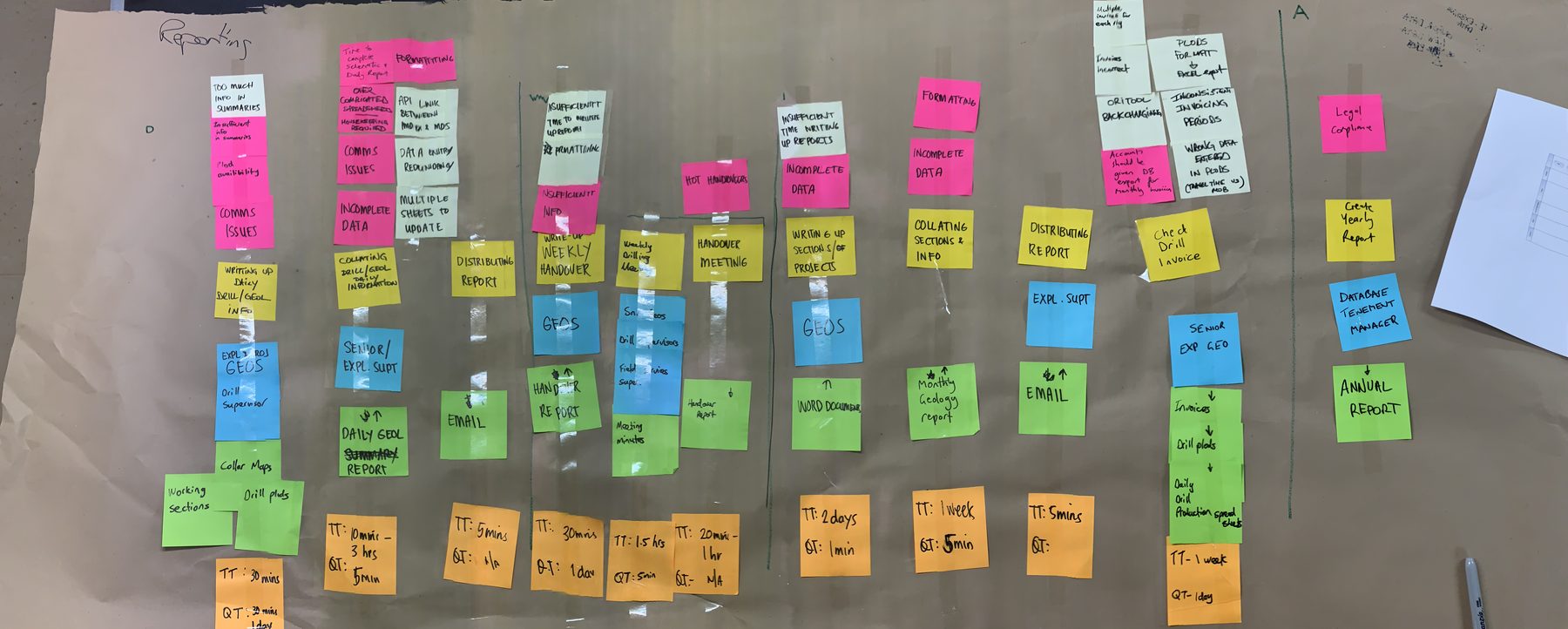
MIM · Speed · VSM
One sticky colour per kind of note. Map the work with the people who do it.
Click to zoom
P
MIM · Speed · Value CVA Customer value-addBVA Business value-addNVA Non value-add
Before: CVA 15%, BVA 40%, NVA 45%. After: CVA 60%, BVA 20%, NVA 20%. (Figures from the original chart.)
Hover a segment to see its share.
P
MIM · Mass
Using what Systems ArchitectureSoftware Hardware AI goes here Sector 3 · Technology Using what Plant & Equipment
P
MIM · Mass
Who Capability MatrixSkills Qualifications, certifications →
Who RolesWhich roles utilize which skill →
Who PositionsRelated directly to an FTE Many-many relationship with roles
I
I · Sector 2 · Information
Make it visible.
Turn reliable data into informed decisions. The right information must reach the right place, in the right form, at the right time.
01 A source of truth for every key data point02 Role-relevant access and presentation03 KPIs connected to Key Result Areas04 Trends, anomalies, comparisons and dashboards
On the pit wall Telemetry helps the engineer make the call.
[Sources] Content: user-provided meeting text and the approved PIT Stop outline (formerly CBA). Website copy: sfgtechsolutions.com, The SFG PIT Stop section.
Visual: AI-generated for this presentation; abstract display contains no sourced statistics.
I
Data Mapping · Kano Model
← Fulfillment →
Customer satisfaction →
Delighters The value added characteristics. Your customers will not ask for these.
e.g. chocolate on the pillow Satisfiers Performance characteristics. Your customers directly request these.
e.g. size of room, view etc. Dissatisfiers Basic expectations. Your customers will not tell you what these are.
e.g. toilet paper and clean towels
T
T · Sector 3 · Technology
Choose the tech that fits.
Apply technology after the foundations are clear. AI is treated as a set of automation tools, not the starting point for transformation.
01 Repetitive administration02 Manual data handling03 Delays and bottlenecks04 Translation and information processing05 Reporting and workflow automation
At the wheel A wheel gun is built for one specific job.
[Sources] Content: user-provided meeting text and the approved PIT Stop outline (formerly CBA). Website copy: sfgtechsolutions.com, The SFG PIT Stop section.
Visual: AI-generated for this presentation; no factual claim is conveyed by the image.
AI & Automation · T
Two habits that change
01 An AI that understands you
02 A better conversation
SECTOR 3 AI is the accelerator, not the engine
Your starting point: one real task you want to improve.
8 MINUTES | 0:00–0:08
Bridge from Bobby: P is Process: map the work. I is Information: one trusted source. T is Technology: AI is the accelerator, not the engine. P and I supply the foundations.
Opening: Bobby has shown us how to improve the work and establish information we can trust. Now we will practice two habits that make AI more useful in everyday work.
Ask participants to choose one task: a customer follow-up email, meeting actions or a staff update. Use an approved AI application and a fictional or non-sensitive example. Have a device-free option: pair with someone or write the prompt on paper.
Run the baseline request: Write a follow-up email after a customer meeting. Save it for comparison. Ask what is missing, how much editing it needs and whether it sounds like them. Do not invent performance claims.
Today's promise: a reviewed working profile and a repeatable conversation method.
Brand source: https://usa.sfgtechsolutions.com/ (accessed October 14, 2026). Workshop content developed for this session. Images are illustrative site artwork, not evidence of an actual event.
Habit 01
Your digital reflection
A working profile that helps AI support you
TRY THIS “Help me create a working profile. Ask me one question at a time. Then summarize it for my review.”
Copy the full prompt
Understanding you includes challenging your assumptions.
20 MINUTES | 0:08–0:28
3 min explanation, 5 min demonstration, 9 min participant practice, 3 min debrief.
Explain: digital reflection means context, examples and feedback. Creating a profile is not retraining the underlying model and does not make AI a copy of you. Reuse the approved profile with a task. Persistence depends on the application and settings, so do not promise every future conversation will retain it.
Full demonstration prompt: Help me create a working profile so you can support me effectively. Ask me one question at a time about my role, goals, values, communication style and boundaries. Do not assume the answers. Ask for an example of my writing and how I like to make decisions. Then draft a concise profile for me to review and reuse. Include an instruction to challenge weak assumptions respectfully, separate facts from guesses and request approval before external actions.
Use a fictional business owner for the demonstration. Answer several questions, then ask for a provisional profile based on what is known and list the gaps. Do not rush personal disclosures.
Participants create a short profile. Review and correct it before reuse. Use only information appropriate for their approved tool. Ask: What did AI assume about you? What did you change?
Output: a reviewed working profile.
Habit 02
Better conversations. Better results.
01 Outcome What should the result achieve?
02 Context Who is it for, and what matters?
03 Questions What does AI need to ask me?
04 Draft What format will be useful?
05 Review What is missing or unverified?
“Before you draft, ask me one question at a time.”
Then ask: “What assumptions did you make, and what would you improve?”
20 MINUTES | 0:28–0:48
3 min explanation, 6 min demonstration, 8 min practice, 3 min debrief.
Show the baseline follow-up again. Then add the reviewed profile, a clear desired outcome and fictional meeting notes.
Full prompt: I need a customer follow-up email that secures a clear next step. Use my reviewed working profile. Audience: an operations director considering a workshop. Context: we discussed repeated manual reporting, but have not agreed a budget or date. Outcome: agree a short scoping call. Format: a warm email under 150 words. Before drafting, ask me up to three questions, one at a time, that would materially improve the email. Flag missing facts rather than inventing them.
Answer the questions live. Ask: Review this against my goal. What is unclear, what assumptions have you made, and what would you improve?
Explain that clarification can improve a task brief but AI can still make mistakes. Confirm factual claims against the original notes and review the draft before sending.
Participants repeat this method on their chosen task. Encourage short spoken prompts where the approved tool supports voice. Pair participants if necessary.
Debrief: Which question changed the result most? What did you still need to verify?
Take it home
Two habits to start tomorrow
01 Give AI your context Reuse your reviewed working profile with the task.
02 Let AI ask you questions Clarify the goal, review the draft and verify the facts.
Your commitment
7 MINUTES | 0:48–0:55
2 min compare, 3 min sharing, 2 min commitment.
Put the original and improved output beside each other in the demonstration tool. Ask participants to identify what changed and what still needs human judgment.
Invite two brief examples from the room. Keep this participatory and avoid turning it into a tool feature tour.
Each participant writes the task, when they will try it and how they will assess it. The owner is the participant. Baseline: current time spent and typical corrections. Measures: time spent, corrections needed and usefulness for the intended recipient. No promised savings.
Reinforce the two takeaways: a reviewed profile and a better conversation. Allow a final practical question before the closing slide.
The next horizon
What if your whole business
AI that understands your business
Your processes. Trusted information.
Connected work, with human approval
P ProcessI InformationT Technology
If you could give your team back five hours a week , where would you start?
5 MINUTES | 0:55–1:00
Reveal the next horizon without turning the close into another lesson.
Say: Today you have started helping AI understand you and learned how to get better results through conversation. Now imagine applying that across your business: less repeated work, clearer decisions and more time for people.
Examples to discuss as possibilities, not current deployments or guarantees: an assistant preparing a customer brief from approved records, a team finding consistent answers in maintained procedures, or a workflow drafting meeting actions for the owner to approve. Access controls, trusted information and human approval remain essential.
Click to reveal the closing question and pause: If you could give your team back five hours a week, where would you start? Five hours is a hypothetical discussion prompt, not a promised result.
Invitation: Bring that process to Bobby or me after the session. We can discuss the friction, establish a baseline and identify one controlled pilot to test. Return to the PIT Stop: map the process, establish trusted information, then apply the technology.
Brand tagline: People-Focused Transformation, Underpinned by the Latest in Technology.
Pit wall · Small business · Northside Trade Co. (fictional, 12 people)
Run like a Fortune 500.
A fictional 12-person trade business. Click a KPI to change the chart. Switch week, month, quarter. Approve the AI crew's suggestions and watch the numbers and hours-back move. Jobs update live.
AI layer (top right): Ask AI opens a scripted assistant that highlights the panel it is talking about; Brief me writes the morning brief with Do-it buttons; the P / I / T lens dims everything but that sector; Today / After PIT Stop shows the illustrative after-state.
All figures are illustrative, not client data.
Pit wall · Medium business · Meridian Distribution (fictional, 140 people)
One version of the truth.
A fictional 140-person distributor. Switch departments across the top. Hover the line chart for monthly actual vs target. Cycle time shows where the process is slowest (P), data quality shows which systems to trust (I), and the agent panel shows the automation at work (T).
Pit wall · Enterprise · Summit Group (fictional, 12,000 people)
One operating model. Live.
A fictional 12,000-person group. Click a region or a map hub. Click portfolio bubbles (coloured by PIT sector) and risk cells for detail. Drag the adoption slider to model benefit, hours returned, payback and the agent fleet.
Pit wall · Digital twin · Ironbark Manufacturing (fictional site)
Click the building.
A 3D model of a fictional manufacturing site: office and administration, receiving, storage, production lines, quality control, maintenance, and distribution and dispatch. Drag to rotate, scroll to zoom, click any area to fly to it and open its dashboard. Forklifts and pallets move live.
PIT lane open · Book your PIT Stop
Ready to take the strategic pause?
P → I → T → Measure
Small business · 1–19 people Beyond5 PIT Stop Process, Information and Technology in plain language, delivered locally.
Growing · 20–199 people Business PIT Stop One workflow, one baseline, a measured plan.
Enterprise · 200+ people Executive PIT Stop A private session on one consequential workflow, with the order of fixes.
Talk to the team at SFG today. Bring one process; leave with a baseline.
Scan to book Book a PIT Stop
Final call to action. Click through P, I, T, Measure, then the three PIT Stop options (Beyond5 for small business, Business for growing organisations, Executive for enterprise), then the booking panel.
People can scan the QR code to book, or fill in the form on screen. Choosing a company size lights up the matching PIT Stop. Submissions go to SFG by email.
Close: people-focused transformation, underpinned by the latest in technology. Talk to the team at SFG today.

 OpenAI
 Anthropic
 Grok
 DeepSeek
 Microsoft
 Google


 Kingdom.com


 YWAM


 Click to zoom